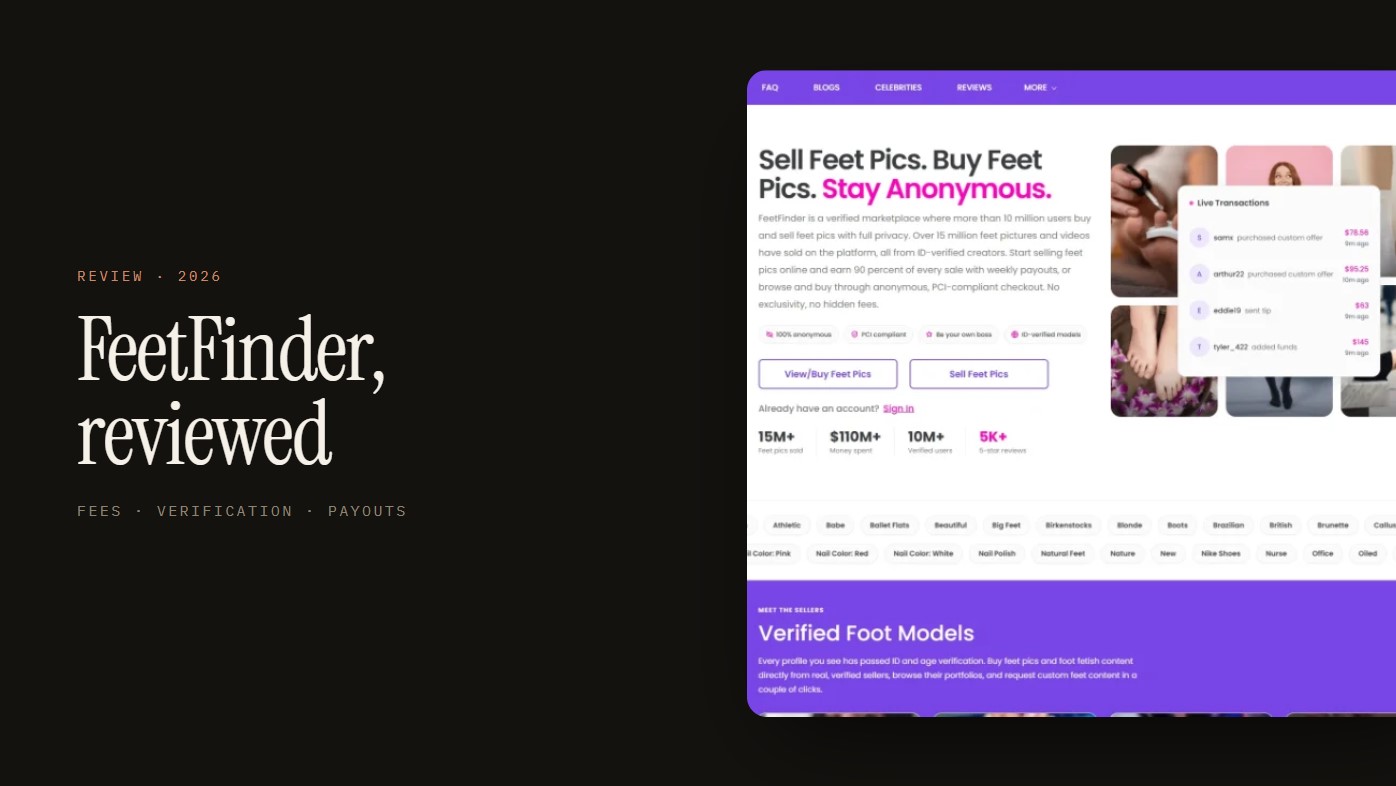
FeetFinder is a well-known and real feet pics marketplace, but that doesn't automatically make it the best in the category. Sellers pay to join, give up a cut of each sale and complete identity verification before they can earn. Some sellers find repeat buyers, but others can spend weeks posting and answering messages without covering the membership cost. Is selling feet pics still worth it? And where to sell feet pics?
This review separates platform legitimacy from seller reality. We'll look at the current fees, payout terms, privacy limits and the work involved, using published information rather than viral income screenshots. You'll also learn where unexpected costs or delays can arise and how FeetFinder compares with paid alternatives such as Feetpik and broader creator platforms. The goal is simple: help you work out which platform is the best fit for you and take a closer look at the topic of selling feet pics before you pay.
FeetFinder review: the short verdict
FeetFinder is a legit feet marketplace with a big user base of more than 12,000,000 users. On FeetFinder, users have spent more than $125,000,000, and 15,000,000 feet pics have already been sold. This makes FeetFinder the biggest feet marketplace. It has seller verification, published terms, payment processing and an established marketplace presence. Those are useful signs that the platform itself is legit. They don't prove that a new seller will attract buyers, recover their costs or earn a worthwhile hourly rate.
Sellers pay to participate, as on other feet marketplaces. FeetFinder also keeps a portion of each sale (from 10% to 20%, depending on your selected plan).
Earnings appear to vary widely. A polished profile in a popular niche may receive regular orders, while another seller can upload comparable content and make little or nothing. Headline income claims on social media are poor evidence because they rarely show subscription costs, commission, refunds, promotional work or how long it took to build an audience.
Verification is mandatory. You may use an alias on your public profile, but you won’t be anonymous to FeetFinder, its verification provider or relevant payment partners. Public-facing privacy also has practical limits: buyers can see what you publish, and any image shared online can potentially be copied or connected to you through usernames, backgrounds, tattoos or other identifying details.
Who FeetFinder may suit
FeetFinder may suit an adult seller who treats the membership charge as a testable business expense rather than guaranteed seed money. Honestly, membership really only costs a few dollars a month, so it's worth giving it a try. You’ll need enough spare time to create consistent content, reply to messages and assess custom requests without assuming every conversation will become a sale.
It’s also a more plausible fit if you’re comfortable completing identity checks, can tolerate uneven demand and already have firm boundaries around what you’ll produce. Sellers who understand that niche marketplaces still require promotion and customer service will generally have more realistic expectations.
Before committing, compare the total cost and audience fit with other options. Feetpik is another paid, commission-based feet content marketplace worth checking, but its current verification, privacy and payout rules need the same scrutiny.
Is FeetFinder legit, and how does it work?
The seller journey starts with creating an account and confirming that you’re at least 18. FeetFinder requires identity and age verification, which typically means submitting government-issued identification and completing the requested selfie or facial check. Your real details are used for verification even if you later display an alias to buyers.
Once approved, you build a profile, add a bio and upload content for sale. Listings need clear previews, descriptions and prices, while custom requests are usually discussed through the platform’s messaging system. A message isn’t an order: don’t create or send the finished content until the buyer has paid through the platform and the transaction appears in your account.
After a sale, the platform deducts its applicable charges and moves the remaining amount through its balance process. Funds may not be immediately withdrawable. When the balance becomes eligible, you can request a payout through a supported method, subject to account, country and payment-processor requirements.
Marketplace legitimacy versus earning potential
FeetFinder is a legitimate operating marketplace in the practical sense: it has an established trading history, published terms and policies, mandatory identity checks, on-platform payment processing and a defined seller payout system. Those are more useful signals than screenshots from influencers claiming they made hundreds of dollars in a weekend.
Legitimate doesn’t mean complaint-free. Sellers can still experience verification problems, slow support, payment reviews, disputes or messages from people attempting to move conversations off-platform. No marketplace—including FeetFinder, Feetpik or a larger creator platform—can guarantee that every user will behave honestly or that every piece of uploaded content will remain private.
Most importantly, legitimacy says nothing about demand for your account. Paying for access doesn’t buy a queue of customers. Results depend on pricing, content quality, consistency, promotion, buyer preferences and competition, and some approved sellers may make few or no sales.
What sellers are actually responsible for
FeetFinder supplies the marketplace and transaction framework; it doesn’t run the business for you. Sellers are responsible for uploading only content they own and are permitted to sell, following platform rules, describing listings accurately and setting firm limits for custom requests.
You’ll also need to recognise suspicious behaviour. Keep payments and delivery on-platform, don’t accept emailed “payment confirmations,” and don’t pay a buyer to release supposed funds. Check the balance inside your account instead of trusting screenshots or links sent in messages.
Finally, keep copies of order details and earnings records, respond professionally, and account for refunds, disputes and taxes where applicable. Platform moderation can reduce risk, but it can’t replace basic record-keeping, sensible boundaries and your own judgement.
FeetFinder fees and membership costs
Membership charges
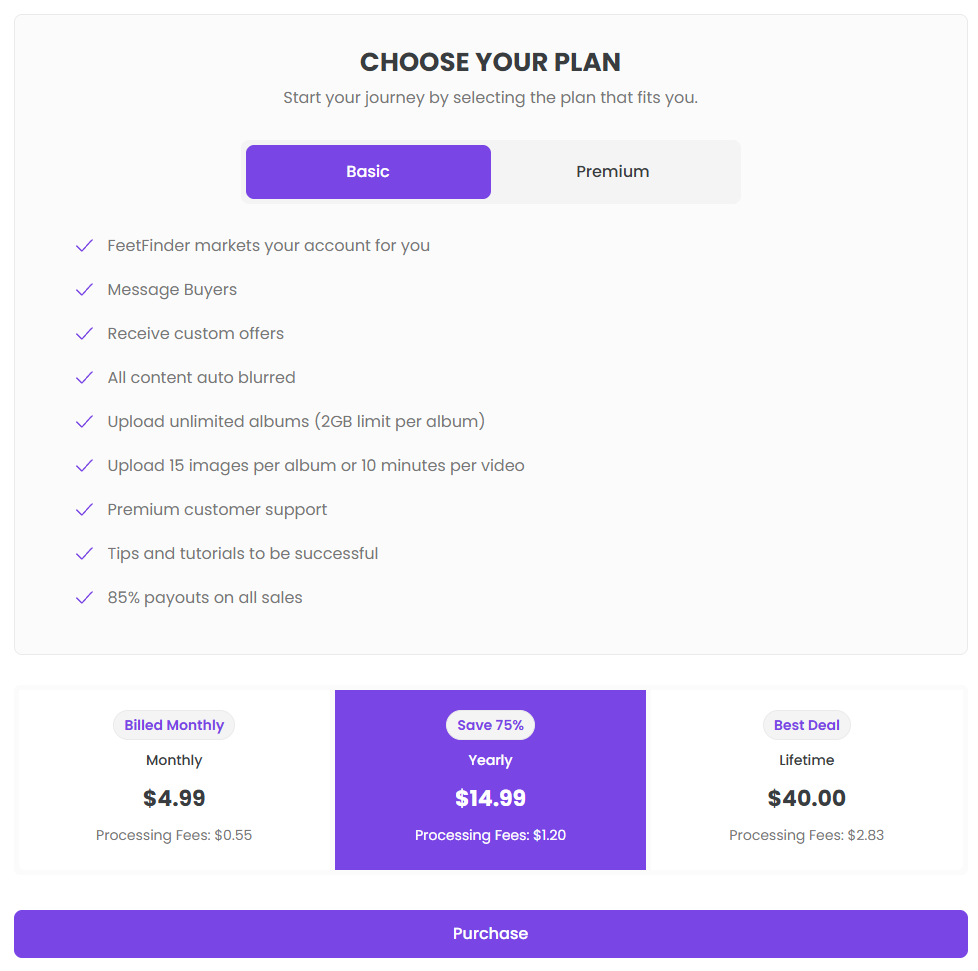
FeetFinder requires sellers to buy a membership before using the marketplace. The prices below were displayed in the seller signup flow and checkout on 3 August 2026. Prices are in US dollars; applicable sales tax, VAT or similar local tax is calculated at checkout from the billing location.
| Seller plan | Billing period | Displayed price | Main fee difference |
|---|---|---|---|
| Basic monthly | 1 month | $4.99 | 20% seller commission |
| Basic annual | 1 year | $14.99 | 20% seller commission |
| Basic lifetime | lifetime | $40.00 | 20% seller commission |
| Premium monthly | 1 month | $14.99 | 10% seller commission |
| Premium annual | 1 year | $49.99 | 10% seller commission |
| Premium lifetime | lifetime | $80.00 | 10% seller commission |
These figures come from FeetFinder’s live signup pricing, checkout disclosures and current terms rather than third-party review sites. That matters: older articles still mention cheaper legacy subscriptions or commission rates that are no longer shown to new sellers.
Commission and transaction deductions
Basic sellers currently give up 20% of each sale, while Premium sellers give up 10%. The upgraded plan therefore makes more sense only when the commission saving outweighs its higher membership charge. On annual pricing, Premium costs $35 more than Basic, so the lower commission breaks even at roughly $350 in annual gross sales.
FeetFinder also adds a 10% buyer service fee to transactions. That doesn’t come out of the seller’s listed price, but it can still affect conversions: a buyer considering a $20 order sees $22 before any tax or other checkout adjustment. Sellers should price with the buyer’s final total in mind, especially for small bundles and paid messages.
What a sale leaves after fees
For a straightforward $20 sale, a Basic seller keeps $16 after the 20% commission. A Premium seller keeps $18 after the 10% commission. Membership cost still needs to be deducted separately when calculating actual profit.
For example, one $20 sale during a Basic monthly subscription leaves $11.01 after the $4.99 membership charge, before tax on the subscription and before allowing for your time. One Premium monthly sale leaves just $3.01 after commission and the $14.99 subscription. Honestly, the upgraded plan’s maths improves only once sales become regular.

Identity verification, approval and account eligibility
FeetFinder requires sellers to be at least 18 years old and complete identity verification before selling. Parental permission doesn’t make a minor eligible. The check links the account to a real adult and helps FeetFinder and its payment partners meet age, fraud-prevention and payment rules.
The usual flow is straightforward: enter your legal details, upload an accepted identity document, complete a facial check and wait for review. Some applications are approved quickly, while others are sent for manual review or returned for another attempt.
What information sellers may need to provide
Expect to provide your legal name, date of birth, residential address and country of residence. These details should match the information on your identification and, later, any payout or tax records requested.
Accepted documents can depend on the seller’s country and the verification provider’s on-screen options. Common examples include:
- A valid passport
- A government-issued driving licence
- A national, state or provincial identity card
You may need to photograph both sides of the document. FeetFinder can also request a selfie, a selfie taken with the ID, or a liveness check that asks you to position or move your face on camera. This is intended to confirm that the applicant is a real person and matches the document photograph.
You can generally use an alias as your public seller name. However, that doesn’t make you anonymous behind the scenes: FeetFinder, its identity-verification provider and relevant payment partners may know your legal identity.
Why verification can fail
A failed first attempt isn’t necessarily a rejection. The system may ask you to upload fresh images or repeat the facial check. Common causes include:
- Blur, glare, shadows or fingers covering document details
- A cropped image that excludes the document’s edges
- An expired, damaged or unsupported form of ID
- Different names, birth dates or addresses across submitted records
- A selfie that’s too dark or doesn’t clearly match the ID photograph
- Uploading a scan, screenshot or edited image instead of a live photograph
Approval can also take longer when automated checks can’t read a document, an application needs manual review, or demand is unusually high. Don’t create duplicate accounts to work around a delay; that can make the review more complicated. Follow the resubmission instructions or contact support using the account’s registered email.
Questions to ask before uploading ID
Read the current privacy policy and verification notice rather than relying on an old review. Check which company processes the identity check, what biometric or document data it collects, how long that data may be retained, and how deletion requests are handled.
Also confirm that your legal name can match your eventual payout account, that your document type is supported, and that you’re comfortable with the distinction between public privacy and platform anonymity. If you wouldn’t submit ID to FeetFinder or its contracted provider, you won’t be eligible to sell there.
The day-to-day FeetFinder seller experience
Approval is only the starting line. A seller account still needs to look active, consistent and believable before most buyers will consider spending. That means adding a clear bio, stating what you offer and setting boundaries without turning the profile into a wall of rules.
Listings, albums and custom requests
A single album rarely shows enough range. Sellers typically need several listings covering different themes, angles, footwear, settings or presentation styles. It’s better to create five genuinely distinct albums than upload the same shoot repeatedly with slightly different cover images.
Pricing takes some testing. Cheap listings may attract attention but leave little return for the time spent shooting, editing and uploading. High prices can make an unproven profile easy to skip. A sensible approach is to compare similar active accounts, choose a starting range and review it after a few weeks rather than changing prices every day.
Custom requests involve more work than standard albums. Before agreeing, confirm the deliverables, number of photos or video length, deadline and final price. Don’t begin based on a vague promise that the buyer will pay later. Requests that require new props, extensive reshooting or unusually specific preparation should cost more than content already sitting in your camera roll.
Messaging and buyer quality
Messages can range from straightforward purchase questions to prolonged chats that go nowhere. Some buyers ask for examples, negotiate repeatedly or describe a custom idea, then disappear before placing an order. Visibility and inbox activity can feel encouraging, but neither automatically represents demand.
Short, structured replies save time. Answer the question, quote the price and explain what the buyer receives. If someone keeps pushing for extra previews or free conversation without moving towards a paid order, it’s reasonable to stop engaging. Friendly service matters; unlimited unpaid attention doesn’t.
Buyer quality also varies. A serious enquiry usually includes a defined request, a workable budget and willingness to use the platform’s purchasing process. Endless bargaining, urgency and requests to move elsewhere are poor uses of a seller’s time.
A realistic workload
Running the account can take several hours each week even at low sales volume. One realistic routine might include a two-hour content shoot, another hour selecting and editing files, 30 minutes writing listings, and brief daily checks for messages and order updates. Promotion can add considerably more.
That promotion may involve posting teasers on permitted social channels, maintaining separate creator accounts and testing which posts bring profile visits. Sellers comparing FeetFinder with Feetpik or another paid marketplace should consider the work required to keep each profile current, not just its apparent audience size.
Honestly, quiet periods are normal. You may upload consistently, answer ten enquiries and receive no paid order from them. Treat message volume, profile views and actual sales as separate results, and track the hours spent on each before deciding the account is performing well.
FeetFinder payouts: timing, thresholds and deductions
When earnings become withdrawable
A completed sale doesn’t become withdrawable cash immediately. FeetFinder first places the seller’s net earnings in a pending balance. According to its seller payout documentation checked on 3 August 2026, transactions are subject to a seven-day holding period before eligible funds move into the available balance.
The current minimum withdrawal is $30. That means a $25 available balance stays in the account until further cleared sales take it over the threshold. The amount credited is already reduced by FeetFinder’s seller commission; any processor, currency-conversion or receiving-bank fee shown during withdrawal can reduce the final deposit further.
After a withdrawal request, FeetFinder gives a typical processing window of three to five business days. Treat that as an estimate, not a promise. A request submitted late on Friday may not begin moving until Monday, while bank holidays can add another day or two.
Payout methods and regional limits
FeetFinder currently routes seller payouts through its third-party payment partner, with bank transfer or direct deposit offered where supported. The precise transfer rail and any local options are determined by the seller’s country and displayed during payout setup. PayPal, Cash App and Venmo shouldn’t be assumed to be available simply because buyers can use familiar payment methods at checkout.
There isn’t one universal payout menu for every seller. Access depends on the countries supported by FeetFinder’s verification and payment providers, plus sanctions and local banking rules. Its public seller material doesn’t provide a dependable, permanent list covering every territory, so check the payout screen before paying for a long membership. Feetpik and other marketplaces have their own regional limits too; changing platforms won’t automatically solve an unsupported-country problem.
The legal name, date of birth, address and bank-account holder details should match the verified identity on the account. A nickname is fine on a public profile, but entering it as the payout recipient can trigger a manual review or rejected transfer. Payment processors may also request fresh ID, proof of address or banking evidence.
Refunds, disputes and chargebacks
A payout isn’t necessarily final just because the original sale cleared. If an order is refunded, disputed or charged back, FeetFinder can remove the corresponding earnings from the pending or available balance. If money has already been withdrawn, the adjustment may leave a negative balance that future sales must cover.
Processor risk reviews can pause an individual transaction or the entire payout account, particularly after an unusual sales spike, repeated buyer complaints or inconsistent identity information. Keep order messages and proof of delivery inside the platform. That record won’t guarantee victory in a dispute, but off-platform conversations and informal payment arrangements leave far less evidence when a buyer challenges a charge.
Privacy controls, content protection and personal safety
What FeetFinder can protect
You can use a public-facing profile name instead of your legal name. Buyers generally interact with that username and the information, previews and paid content you choose to publish—not the identity documents submitted during verification. That still doesn’t make you anonymous to FeetFinder, its verification provider or payment partners.
Keep location details broad. Don’t put your town, workplace, gym or usual shooting spots in your bio or messages. After setting up the account, view your profile while logged out to see exactly what a buyer can see, including your username, avatar, bio, public previews and any location information you’ve entered.
FeetFinder provides tools for blocking users and reporting accounts or messages. Use them early if someone pressures you for personal details, repeatedly crosses a stated boundary or tries to move payment elsewhere. Platform messaging and payment records also give support more context than a conversation moved to Telegram, Snapchat or email.
Don’t treat platform content controls as digital-rights management. Protection features can change, so check the current upload screen and seller documentation for any automatic watermarking. Even where a platform displays or applies a watermark, adding a subtle seller watermark to previews can help identify reposts; avoid using your real name or a handle connected to personal accounts.
What no marketplace can guarantee
Once a buyer can view an image or video, copying remains possible. They may take a screenshot, record the screen with another device or redistribute the file. Watermarks can be cropped, blurred or removed, and blocking someone doesn’t delete copies they already saved.
Hiding your face reduces exposure, but it isn’t a complete disguise. Tattoos, scars, jewellery, nail designs and distinctive flooring can identify you. So can a street view through a window, a parcel label in the background or reflections in mirrors and taps.
Metadata is another avoidable risk. Platforms may strip some EXIF data during processing, but don’t rely on that happening for every file or message attachment. Remove location metadata yourself before uploading. Reusing a username, profile photo, bio sentence or watermark from Instagram, Reddit or a personal email account can also connect the profiles within seconds.
A practical privacy setup
- Create a new alias, email address and unique password; enable two-factor authentication if it’s available.
- Use a username and profile image that have never appeared on personal social accounts.
- Disable camera geotagging and strip metadata from finished files before upload.
- Shoot against a plain, repeatable background and check frames for mail, windows, reflections and recognisable belongings.
- Cover identifying marks or decide in advance which ones you’re comfortable showing.
- Watermark previews without revealing your legal name, email address or personal social handle.
- Keep conversations and payments on-platform, and never share your home address, workplace or daily routine.
Run the same privacy check when comparing FeetFinder with Feetpik or another paid marketplace. Account controls help, but your shooting setup and separation from your offline identity do most of the real work.

Common complaints, scams and seller mistakes
Complaints that reflect the business model
The most understandable complaint is having to pay before making a sale. That isn’t evidence of a scam; it’s how the seller membership works. Still, it means a seller can spend money, upload content and receive no paid orders. Low visibility is another recurring theme, particularly from new accounts expecting the marketplace to supply ready-to-buy customers.
Unwanted messages also appear frequently in public reviews. Sellers report time-wasters, requests for free samples and buyers pushing conversations elsewhere. Verification friction is a related but separate issue: ID rejection, repeated selfie checks or mismatched account details can make signup frustrating.
Payout delays and uneven support experiences deserve context. Processing reviews, disputes and identity mismatches can genuinely delay funds, but an individual reviewer saying “I wasn’t paid” doesn’t establish that payouts routinely fail. Likewise, reports of slow or unhelpful support are worth noting without assuming every seller receives the same service.
Some patterns are confirmed by the platform’s published model: membership costs apply without guaranteed sales, verification is required, and payments can be reviewed or delayed. Other claims—such as accounts being “randomly banned” or support never responding—are usually isolated reports unless backed by records or a large, consistent body of evidence.
Public ratings also suffer from selection bias. Someone who encounters a payment problem is more likely to post a review than a seller whose withdrawal arrived normally. At the other extreme, glowing income claims may come from affiliates, unusually successful sellers or people leaving out their advertising costs.
Red flags in buyer messages
Treat any request to move immediately to Telegram, WhatsApp or email as a warning, especially when the buyer promises an unusually large payment. Common scam scripts involve fake payment screenshots, overpayments, gift cards, “release fees” and links claiming you must verify an account before receiving money.
Don’t pay a buyer, deposit a check or share login codes. Keep payment and order details on-platform. For previews, use a tightly cropped, watermarked sample; sending the full pose at usable resolution can give a stranger everything they wanted without a purchase.
Mistakes that make profitability harder
- Buying the longest plan immediately: Test demand with the smallest sensible commitment before locking in more months.
- Underpricing custom work: Charge for planning, setup, retakes, editing and unusual requests—not just the final image count.
- Accepting off-platform payments: You may lose platform records and dispute protections while increasing chargeback and privacy risks.
- Giving away revealing previews: Blur or crop distinctive tattoos, backgrounds and identifying details as well as the paid content itself.
- Ignoring tax records: Track gross sales, platform deductions, membership charges and equipment expenses from day one. A payout total alone isn’t a usable profit record.
FeetFinder alternatives worth comparing
No single selling route wins on every measure. A niche marketplace may provide better buyer intent and moderation, while a large creator platform offers more tools but expects you to bring an audience. Compare the total cost, not just the signup price.
Paid niche marketplaces
Feetpik is another paid, commission-based marketplace built specifically for feet content. That gives it a more relevant audience than a general social network, but sellers should still review its current membership price, sales commission, identity checks, privacy controls and payout availability before joining. Paid access doesn’t guarantee traffic or orders.
Other niche marketplaces follow similar models: some charge a recurring seller fee, some take commission, and some do both. Their main advantage is audience fit—visitors are already looking for this type of content. The trade-off is a smaller buyer pool, uneven discovery and dependence on the site’s search or ranking system.
Check how each service handles custom orders, refunds, blocked users and stolen content. Also confirm that its payout provider works in your country. A promising marketplace isn’t useful if you can list content but can’t withdraw the proceeds conveniently.
General creator platforms
OnlyFans and Fansly generally don’t charge creators an upfront membership fee, but both retain a percentage of creator revenue; their published standard platform share has commonly been 20%, although current terms should be checked before signup. They support subscriptions, paid messages, tips and locked posts, which can work better for recurring income than one-off photo listings.
The catch is discovery. OnlyFans, in particular, is usually closer to a checkout and content-delivery system than a buyer marketplace, so creators often need traffic from elsewhere. Fansly offers more internal recommendation features, but visibility still isn’t automatic.
These platforms also serve broad adult audiences rather than feet buyers alone. That can expand the potential market, yet it may bring requests outside your niche. Compare content rules, moderation response, payout minimums, waiting periods and country support before building a following on either platform.
Direct selling and social promotion
Reddit communities, X, Instagram, TikTok and specialist forums can provide promotion without a marketplace membership charge. They’re useful for testing which styles attract attention, but each community has its own rules around adult content, solicitation and external links. Accounts or posts can disappear with little warning.
Direct selling gives you more control over prices and customer relationships, but it carries the highest scam and payment risk. Fake payment screenshots, chargebacks, stolen previews and impersonation are common problems. Mainstream payment apps may also restrict adult-content transactions, leaving sellers with frozen funds or closed accounts.
If you promote socially, sending buyers to a compliant marketplace or creator platform is generally safer than negotiating payment in private messages. You’ll sacrifice commission, but gain transaction records, defined content rules and at least some moderation when a dispute occurs.
Pre-signup checklist: decide whether the numbers work
Before entering card details, confirm that sellers in your country are currently eligible and that a supported payout method works there. Don’t assume account access means you can withdraw earnings. Check the live seller documentation, then take screenshots of the checkout price, currency, taxes, billing period and any introductory discount.
Read the renewal and cancellation wording before paying. Note when the plan renews, how cancellation works and whether cancelling stops future billing or also affects access already purchased. Do the same comparison with Feetpik or another marketplace; total cost matters more than the price shown in an advert.
Five figures to write down before paying
- Your total subscription charge: Use the final checkout amount after tax and currency conversion, not the headline price.
- Your realistic average order value: Base this on prices you’d genuinely charge, including higher-effort custom requests.
- Your average net sale value: Deduct the platform commission and any predictable payment deductions. A $15 order isn’t worth $15 to you.
- Your unpaid working hours: Include shooting, editing, uploading, promotion and messages. Ten minutes here and there can easily become six hours.
- Your maximum acceptable loss: Set this before launch. For example, you might cap membership spending at $30 and refuse to renew unless cleared earnings have already covered it.
Cash break-even sales = subscription cost ÷ average net sale value.
If membership costs $30 and each sale leaves you $8 after commission, you need 3.75 sales—so, in practice, four completed sales—just to recover the fee.
For a more honest calculation, price your time: (subscription cost + unpaid hours × target hourly rate) ÷ average net sale value. At six hours, a $15 hourly target and an $8 net sale, the break-even point becomes 15 sales, not four. This isn’t money you’ve physically spent, but it shows whether the test is worth your time.
A 30-day test plan
Start with the shortest sensible commitment rather than buying a long plan because its monthly equivalent looks cheaper. During the first 30 days, record paid orders, net earnings, refunds, serious enquiries and hours worked. Don’t count likes, profile views or unpaid promises as revenue.
Prepare your privacy rules before uploading anything: use a separate email and public alias, remove metadata, check backgrounds and watermark previews where appropriate. Write down your non-negotiable boundaries too—face visibility, identifiable tattoos, outdoor locations, off-platform contact and categories of custom requests you won’t accept.
At day 30, renew only if cleared net earnings, workload and privacy exposure meet the limits you set beforehand. If they don’t, cancelling is a business decision, not a failure.
Final verdict: is FeetFinder worth paying for?
FeetFinder can be worth a limited test, but only if you treat it as a paid sales channel rather than an income shortcut. A sensible candidate is an eligible adult who’s comfortable completing identity verification, has checked the full cost at checkout, accepts that demand may be patchy and has a clear privacy plan before uploading anything.
The key word is test. Don’t buy more access than you can comfortably write off, and don’t build a monthly budget around sales that haven’t happened. Set a spending limit and a review date—30 or 60 days, for example—then judge the platform by your own numbers: paid orders, net revenue after all deductions, time spent on messages and content, and how many enquiries actually converted.
It’s a weaker proposition if you need immediate profit or expect the membership payment to produce guaranteed traffic. The same applies if full anonymity is non-negotiable. You may use a public alias, but verification and payment processing mean you won’t be anonymous to every party involved. Sellers who need rapid access to every payment may also find marketplace processing, holds or reviews too restrictive.
Personal comfort matters just as much as the maths. If promoting content makes you uneasy, if you’d feel pressured to accept requests outside your limits, or if the possibility of copying and redistribution is unacceptable, a positive earnings estimate doesn’t make the platform a good fit. Those aren’t minor drawbacks to “work around”; they’re valid reasons not to sign up.
Before paying, compare FeetFinder with Feetpik, OnlyFans, Fansly and other niche marketplaces using the terms available on the day you join. Feetpik is also a paid, commission-based marketplace, so include its membership costs, sales deductions, verification rules and payout options rather than assuming it’s automatically cheaper or easier. For every platform, check whether withdrawals are supported where you live and how long money may remain unavailable.
Ignore screenshots of unusually high earnings and testimonials that don’t show expenses, hours worked or an ordinary month. Headline revenue tells you very little about what you are likely to keep.
The bottom line: FeetFinder may justify a cautious, budget-capped trial for someone who understands the costs, accepts verification and can tolerate uncertain results. It isn’t a strong choice for anyone relying on quick returns, automatic discovery, complete anonymity or instant payouts. Choose based on current total cost, payout access and your own boundaries—not somebody else’s best month.